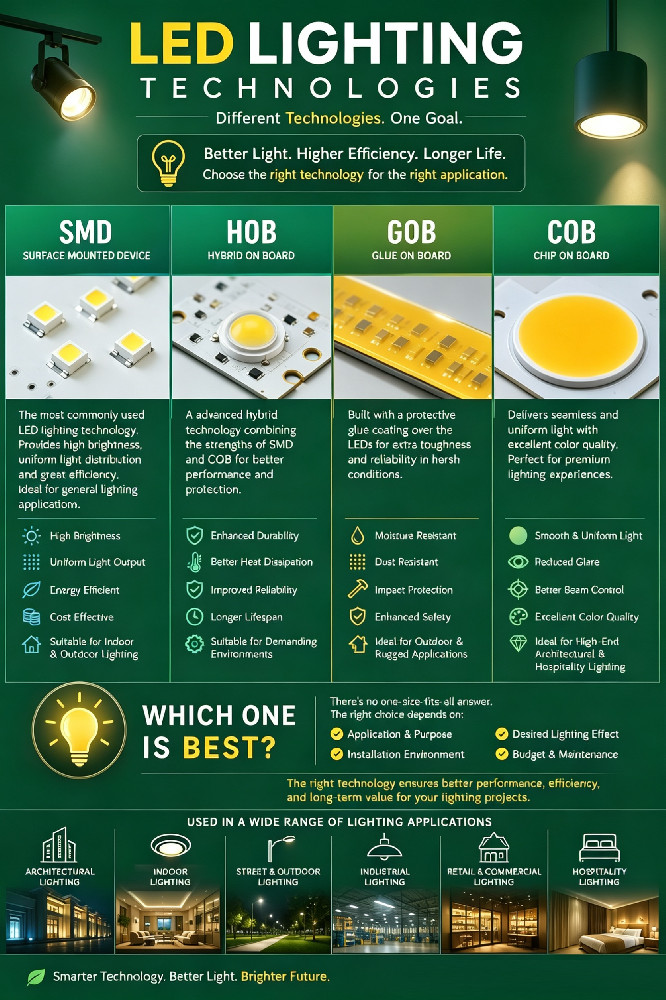

SMD, COB, GOB, and HOB are not four equal categories. SMD and COB describe common LED packaging or board-mounting approaches. GOB usually describes a protective resin layer over an LED display module. HOB appears mostly as a supplier-defined display-module term, often positioned between COB-style integration and GOB-style surface protection. For architectural outdoor lighting buyers, the best question is not “which acronym is best?” but which package, optic, thermal path, protection method, and service method match the project.
Quick Answer For HOB, COB, GOB, And SMD
| Term | Plain-English meaning | Best way to verify it |
|---|---|---|
| SMD | Surface-mounted LED packages are placed on a circuit board as separate components. | Ask for LED package type, board layout, optical cover, and thermal path. |
| COB | Chip-on-board places many LED dies close together on a substrate, often creating a compact light-emitting area. | Check module drawing, heat path, beam control, and glare behavior. |
| GOB | Glue-on-board normally adds a transparent resin or coating layer over LED modules, especially in display products. | Confirm coating material, surface finish, repair method, and environmental use case. |
| HOB | HOB is less standardized; suppliers may use it for hybrid, hollow, or high-protection on-board concepts. | Ask the supplier to define the structure in writing before comparing it with COB or GOB. |
Why The Terms Are Often Confused
Search results for LED HOB and HOB COB mix architectural lighting language with LED display language. That creates confusion: a display module designed for pixel protection is not the same decision as an outdoor spotlight, wall washer, or in-ground luminaire. A fact-safe comparison should separate package structure from fixture performance.
- Packaging: how LED chips or packages are mounted and connected.
- Optics: how the light is shaped after it leaves the emitting surface.
- Thermal path: how heat moves from chip or package to housing and air.
- Surface protection: whether the LED surface is exposed, covered, resin-coated, or sealed inside a fixture.
- Project fit: whether the finished product works for flood lighting, wall washing, in-ground accents, display screens, or interior modules.
SMD vs COB: Core Lighting Difference
| Decision point | SMD | COB |
|---|---|---|
| Light source appearance | Multiple packaged points, often softened by lens, diffuser, or reflector design. | More concentrated emitting area that can read as one source. |
| Optical control | Flexible for arrays, linear boards, and broad area designs. | Useful where a compact source helps beam shaping or accent control. |
| Thermal review | Review board layout, spacing, housing contact, and current setting. | Review substrate, heat spreader, housing contact, and high-output operation. |
| Outdoor project question | Is the light distribution even enough for the surface? | Is the source controlled well enough to avoid glare and hot spots? |
| Best-fit examples | Area modules, linear boards, compact multi-LED layouts, general illumination. | Spot modules, downlights, accent engines, compact high-intensity designs. |
GOB And HOB Are Usually Protection Conversations
GOB is most often discussed in LED display modules where surface protection, contact risk, cleaning, and pixel visibility matter. HOB appears in similar display-module conversations, but the exact meaning varies by supplier. For outdoor architectural luminaires, it is safer to ask what the finished fixture does rather than assume that a display-module term proves better flood-light or in-ground-light performance.
| Question | Why it matters | Fact-safe buyer action |
|---|---|---|
| Is this a luminaire or a display module? | The same acronym can describe different product categories. | Separate architectural lighting products from video-wall or screen modules. |
| What is the protective layer? | Resin, silicone, lens, glass, and housing seals solve different problems. | Ask for material description and drawing instead of relying on the acronym. |
| Can the module be serviced? | Some structures are easier to access than others. | Ask how damaged LEDs, optics, or surface layers are handled. |
| How is glare controlled? | A protected surface can still be visually uncomfortable. | Check lens, shield, louver, trim, and aiming options for the application. |
| What data supports the claim? | Marketing labels can sound similar while test scope differs. | Request product drawings, photometric files, thermal notes, and application limits. |
Choosing For Outdoor Architectural Lighting
For facade, landscape, and civic exterior projects, the LED package is only one layer of the decision. Beam angle, mounting position, housing material, glare control, drainage condition, driver setting, and project access usually have more impact on the final result than the acronym alone.
| Project need | More useful comparison | Internal planning page |
|---|---|---|
| Facade accent or wall washing | Beam shape, mounting distance, glare shield, and surface texture. | Beam angle guide |
| In-ground uplighting | Recess detail, drainage condition, trim style, and pedestrian comfort. | LED in-ground lights |
| Compact spot or garden accent | Fixture size, bracket method, lens option, and aiming flexibility. | LED flood light families |
| Higher-output exterior projection | Thermal path, beam control, mounting access, and target distance. | High-power flood lights |
| Wall-mounted exterior lighting | Wall surface, upward or downward distribution, cutoff, and cable route. | LED wall lights |
Buyer Review Record For LED Package Terms
| Record item | Why buyers need it | Fact-safe note to request |
|---|---|---|
| Exact supplier definition | HOB and similar labels can vary by supplier and product category. | Ask the supplier to define the term for the exact product line in writing. |
| Product category | A display module, light engine, and finished luminaire solve different problems. | Confirm whether the term describes a module, a source board, or the finished fixture. |
| Optical control path | The package name does not explain beam shape or glare behavior by itself. | Review lens, reflector, shield, trim, and aiming notes together. |
| Thermal path | Heat movement affects stable operation and product matching. | Ask for the heat path, substrate, housing contact, and normal operating condition notes. |
| Support files | Terminology is easier to compare when drawings and photometric files are available. | Use drawings, optical files, and application notes before final product selection. |
Search Intent Split For HOB, COB, GOB, And SMD
| Search phrase | Likely user intent | Safer page answer |
|---|---|---|
| HOB LED | User is trying to understand a less-standard supplier term. | Explain that the term needs supplier definition before technical comparison. |
| HOB COB | User is comparing a less-standard label with a clearer package structure. | Separate COB structure from supplier-defined HOB wording. |
| GOB LED technology | User may be reading display-module protection language. | Clarify that display protection language should not be copied directly into luminaire selection. |
| SMD vs COB | User needs a practical light-source comparison. | Compare source appearance, thermal path, optical control, and project fit. |
| LED packaging comparison | User wants a neutral decision framework. | Move from acronym review to drawing, optic, heat path, and application review. |
When To Move From Acronym Review To Product Review
| Buyer signal | What it means | Next review step |
|---|---|---|
| The project needs a specific beam effect | The source label is less important than optical control. | Compare beam file, aiming method, target surface, and glare notes. |
| The product will be used outdoors | Finished housing, sealing method, wiring route, and installation context matter. | Review fixture-level drawings and application limits. |
| The term appears only in supplier copy | The wording may not be a stable industry category. | Ask for a written definition and avoid treating the label as a proof point. |
| The buyer is comparing display and lighting sources | Display modules and outdoor luminaires have different evaluation paths. | Separate pixel protection topics from beam, glare, and fixture-body topics. |
| The specification needs approval | Acronyms alone do not carry enough review evidence. | Use drawings, photometric files, thermal notes, and selected application records. |
Supplier Questions Before You Specify HOB
- What does HOB mean in this product line: hybrid, hollow, high-protection, or another supplier-specific structure?
- Is the product a display module, a light engine, or a finished architectural luminaire?
- Which parts are SMD packages, bare dies, resin layers, lenses, glass, or fixture housing?
- How does the heat move from LED source to housing under normal operation?
- Which optical element shapes the beam after the LED package?
- How is glare reduced for normal viewing angles?
- What drawings, photometric files, and thermal notes can be reviewed before selection?
- How should the product be cleaned, accessed, or serviced after installation?
Common Mistakes In SMD COB GOB HOB Comparisons
| Mistake | Why it causes confusion | Better approach |
|---|---|---|
| Treating every acronym as a direct upgrade path | SMD, COB, GOB, and HOB describe different layers of product design. | Compare structure, optics, protection, and finished fixture role separately. |
| Assuming HOB means the same thing from every supplier | The term is not as stable as SMD or COB in lighting literature. | Ask for the supplier’s written definition and section drawing. |
| Using display-module claims for outdoor luminaires | Screen protection and architectural beam control are different problems. | Match the source category to the project category. |
| Ignoring optics after choosing a package | A good LED source can still create glare if the lens and shield are wrong. | Review beam, cutoff, lens, louver, trim, and aiming together. |
| Choosing by brightness language alone | High output without control can weaken comfort and facade quality. | Check useful light on target surfaces, not only source output. |
Related Radiant Honor Resources
For practical product selection, compare in-ground lights, wall lights, flood light families, and high-power flood lights. For project planning, read the in-ground and wall-wash facade lighting guide, the beam angle guide, and the download center.
FAQ
Is HOB the same as COB?
No. COB has a clearer technical meaning: chips are mounted directly on a board or substrate. HOB is less standardized and should be defined by the supplier before comparison.
Is GOB used for outdoor lighting fixtures?
GOB is most commonly discussed in LED display modules. Outdoor luminaires may use lenses, glass, resin, seals, or housings, but the finished fixture design matters more than the GOB label alone.
Which is better for architectural flood lighting, SMD or COB?
Neither is automatically better. COB can help compact source and beam control, while SMD can support flexible arrays. The final decision depends on optics, heat path, glare control, housing, and target distance.
Why does HOB appear in LED display search results?
Many HOB results describe display modules where surface protection, contrast, and service method are important. That context should not be copied directly into architectural luminaire specifications.
What should buyers ask before accepting an HOB claim?
Ask for the supplier’s written HOB definition, product drawing, optical file, thermal notes, surface material, and service method. Without those details, HOB is only a label.
Does COB always reduce glare?
No. COB can create a compact emitting area that helps some optical designs, but glare depends on lens, reflector, shield, trim, aiming angle, and the viewer’s position.
How should this comparison be used in a project?
Use it as a vocabulary and screening guide. Final product selection should be based on drawings, target surfaces, beam requirements, mounting method, and reviewed product data.
Should HOB terminology decide a lighting fixture by itself?
No. HOB wording should be treated as a term to clarify, not as a complete selection rule. For outdoor architectural lighting, buyers should still review the finished fixture, beam path, heat path, glare control, housing design, and project application before selecting a product.