

Quick Engineering Answer: Within Radiant Honor's source-confirmed 120W–1200W high-power LED flood light range (/m6/ and /m5/), select 36W base-mounted spotlights and 60W–200W R/Q340 fixtures for close-to-medium facades, step up to 300W–600W for tall commercial towers, and reserve 900W–1200W high-output floodlight planning for long-throw bridges, high-mast plazas, and stadium perimeters, confirming exact optics and DMX512/power specs per order.
Long-throw exterior projection—spanning cable-stayed bridge pylons, landmark hotel crowns, civic plaza high-masts, port aprons, and stadium perimeters—punishes superficial catalog selection more severely than any other outdoor lighting discipline. Under the inverse-square law, doubling the throw distance from a setback mounting mast to an upper facade reduces incident illuminance to one-quarter for the same beam intensity. When contractors attempt to compensate by simply ordering headline high-wattage floodlights with wide 60° or 90° flood lenses, over 70% of the emitted lumens miss the architectural target entirely, creating severe light trespass, urban skyglow, and wasted electrical capacity.
To prevent expensive optical mismatches before tender submission, Radiant Honor structures Landscape Spotlights & 1200W Planning (/m6/) and High-Power LED Flood Lights (/m5/) as a disciplined engineering progression rather than a single generic SKU. Importantly, as stated directly on our 1200W LED Flood Light Planning Guide, Radiant Honor customer materials confirm an overall 120W–1200W high-power flood light capability range (alongside 12W–200W R Series and 36W base-mounted references), while final optical distributions, color channels (monochrome CCT vs. RGB/RGBW DMX512), electrical interfaces, and structural bracket drawings are engineered and confirmed per project order prior to quotation.

1. Stepping Up Cleanly: From 36W Base Spotlights to 120W–1200W Long-Throw Banks
Large architectural sites rarely rely on a single wattage tier from ground podium to parapet spire. A riverfront landmark or stadium precinct typically combines ground-level base spotlights for colonnades, mid-power architectural floodlights for 15-to-35-meter facade setbacks, and heavy multi-module projection banks on distant high-masts. Mixing unrelated suppliers across those three zones almost always produces noticeable chromaticity shifts—for example, greenish 3000K on lower columns beneath pinkish 3000K on upper piers—and incompatible DMX512 decoding curves during color fades.
Consolidating the entire projection hierarchy within Radiant Honor's source-backed portfolio lets MEP specifiers step wattage smoothly while keeping consistent LED binning, housing finish, and control behavior:
| Projection Tier & Catalog Reference | Wattage Class | Typical Setback / Mounting Context | Recommended Optical & Mounting Focus |
|---|---|---|---|
| 36W LED Spotlight with Base | 36W | Podium ledges, signage edges, sculptures, entrance walls, courtyard trees | Fixed base or rotatable mount base kit; directional accent beam + glare hood |
| R200 / R300 / Q340 R Series | 60W – 200W | Mid-rise hotel facades, commercial plazas, column rhythm, cornice accents | Private-mold R Series family consistency; seated or U-bracket aiming |
| 120W, 150W & 300W High-Power | 120W – 300W | Multi-story building envelopes, bridge deck arches, public square masts | Confirm narrow vs medium beam spread; verify wind load on elevated arms |
| 480W & 600W High-Power Flood Light | 480W – 600W | High-rise tower setbacks, large industrial/port yards, wide bridge spans | Multi-driver thermal dissipation, DMX512 RDM or monochrome circuit grouping |
| 900W Flood Light & 1200W Planning Path | 900W – 1200W | Supertall crowns, long-span bridge pylons, high-mast area & stadium perimeters | Tight collimated optics for long throw; structural yoke & remote power box review |
Interactive Long-Throw Beam Spot Width & Wattage Planning Tool
Calculate geometric beam spot diameter at your target facade or plaza surface (`D = 2 × Throw × tan(Angle / 2)`) and identify the matching Radiant Honor planning tier:
Geometric Spot Diameter: 14.87 m at 85 m throw (10 deg) | Suggested Planning Tier: 600W–1200W High-Power Flood Light (/m5/ & /m6/) — Request IES simulation & confirm final optic per order.
2. DMX512 RGBW Synchronization, Remote IP68 Driver Enclosures & Thermal Management
When high-output floodlights move from static white area illumination to dynamic architectural storytelling—such as holiday color scenes across skyscraper crowns or synchronized bridge cable chases—electrical and thermal engineering complexity doubles. First, RGBW four-channel LED arrays require balanced current allocation so pure white (W channel) maintains crisp architectural rendering on stone or glass curtain walls while saturated R/G/B channels deliver deep chromatic punch without thermal throttling.
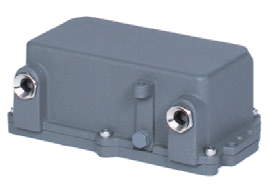
Second, servicing a driver mounted 35 meters up a high-mast tower or suspended beneath a bridge catwalk requires road closures, boom lifts, or rope-access technicians. Forward-looking MEP consultants mitigate maintenance downtime by evaluating driver placement early during design development. Where site cable runs permit, housing power supplies and DMX512 signal gear inside accessible, ground-level or catwalk-level IP68 Waterproof Floodlight Power Boxes isolates heat-generating electronics from the luminaire LED board and shields drivers from torrential monsoon rain and deck washdowns.
3. Structural Mounting Hardware, Glare Louvers & Nighttime Aiming Protocol
A 600W to 1200W luminaire presents substantial effective projected area (EPA) to crosswinds on coastal bridges and rooftop parapets. Standard thin-gauge stamped brackets flex under wind buffeting, causing narrow 5° or 10° beams to visibly oscillate across distant tower facades. Furthermore, without mechanical glare cut-off, high-candela floodlights mounted near observation decks or riverfront promenades blind pedestrians and boat traffic.
| Engineering Subsystem | Companion Radiant Honor Accessory Path | Commissioning & RFQ Verification Point |
|---|---|---|
| Precision Azimuth & Tilt Locking | Rotatable Mount Base Kit & heavy yoke brackets | Verify anchor bolt pattern, locking teeth/set-screws, and structural slab load |
| Spill-Light & Glare Suppression | Radar & Louver Anti-Glare Ring / Deep Anti-Glare Plate | Check compatibility with selected housing frame before bulk production |
| LED Optical Source Architecture | Compare SMD, COB, GOB & HOB in our LED Packaging Guide | Match narrow-throw intensity vs smooth wide-wash color mixing |
| Outdoor Driver & Signal Enclosure | IP68 Waterproof Floodlight Power Box | Confirm feeder distance, cable gland count, and DMX512 daisy-chain topology |
4. Facade Reflectance Compensation, Nighttime Mockups & Clean RFQ Submittals
Photometric calculations performed purely in software often overestimate achieved facade luminance by 35% to 50% when designers assume idealized diffuse white walls. Real landmark structures combine specular dark-tinted curtain wall glass, weathered dark granite piers, brushed bronze mullions, and porous sandstone spandrels. Specular glass reflects narrow upward beams straight into the night sky rather than toward street-level viewers unless fixtures target solid structural transoms, terracotta fins, or ceramic frit bands. Similarly, dark basalt or weathered steel bridge pylons with 12% surface reflectance require roughly three times the incident illuminance of pale 40%-reflectance limestone to register equivalent visual brightness against an urban skyline.
On projects spanning multiple architectural materials—such as civic monuments like the Faisal Mosque Precinct Lighting reference or riverfront commercial towers—seasoned lighting consultants schedule an on-site nighttime mockup before freezing final production optics. Testing two candidate beam angles side by side (for example, a narrow column spot against a medium architectural flood, with and without a radar/louver anti-glare ring) reveals grazing shadows around stone joints, mullion reflections inside occupied hotel rooms, and color rendering fidelity across warm 2700K–3000K white versus dynamic RGBW scenes. Recording the exact aiming tilt angle, setback distance, and approved optic code on the mockup sign-off sheet gives the factory a concrete baseline for batch assembly.
When transitioning from approved mockup to bulk order scheduling, electrical engineers should also coordinate circuit breaker inrush currents, DMX512 universe channel budgets, and feeder cable voltage drop across long bridge or plaza conduit runs. Grouping high-power 480W, 600W, 900W, and 1200W projection banks onto balanced three-phase distribution boards while keeping DMX512 signal lines physically separated from high-voltage AC power conduits prevents signal flicker during synchronized chases. Where bridge expansion joints or high-mast vibration zones occur, specifying flexible weatherproof conduit loops and strain-relieved cable glands preserves ingress integrity across seasonal thermal expansion cycles.
Facility maintenance crews servicing high-mast plazas, port aprons, and stadium perimeters also benefit substantially when aiming reference marks are scribed onto yoke brackets during initial nighttime commissioning. Whenever periodic lens cleaning or structural mast inspection occurs in subsequent years, technicians return each 600W, 900W, or 1200W luminaire head to its exact approved tilt angle without repeating costly night-shift laser aiming across active river spans or roadways. Recording every mast identifier, circuit phase, DMX512 start address, rotatable base orientation, and paired IP68 power box location inside the project handover schedule secures predictable long-term performance across landmark architectural sites.
In mixed-elevation civic complexes—where lower pedestrian podiums sit immediately beneath tall hotel towers or stadium perimeter masts—coordinating the transition between ground-level 36W base-mounted spotlights, mid-level R260 / R300 architectural projectors, and upper-mast 600W–1200W projection banks eliminates dark dead bands midway up the building envelope. Designers overlap the upper beam feather of the podium tier with the lower beam edge of the setback mast tier by 15% to 20% so vertical luminance rises smoothly toward the architectural crown without harsh horizontal cutoff lines or unshielded glare into guestroom windows.
Because high-power projection fixtures are configured to project-specific optical and electrical schedules rather than pulled blindly from retail shelves, submitting five core inputs up front cuts quotation turnaround dramatically: (1) CAD elevation or section showing horizontal setback and vertical target height; (2) target surface material and reflectance (dark steel pylon, glass curtain wall, travertine stone, or turf); (3) control protocol (on/off circuit switching, DALI, or DMX512 RGB/RGBW); (4) local grid supply voltage and preferred driver location; and (5) sample mock-up schedule. Download our Outdoor Lighting Selection Checklist PDF and connect with our Guangzhou engineering team via Contact Radiant Honor to structure your 120W–1200W project package.
Long-throw landmark tenders coordinating podium accents with high-mast banks also evaluate CASE, Beijing National Stadium Exterior Perimeter Lighting, MA64 8W In-Ground Light, 120W Spotlight with Base, 120W Outdoor Architectural Spotlight, 120W Outdoor LED Spotlight, 150W Outdoor Spotlight with Light Shelter, and 150W Outdoor LED Spotlight Selection Guide, alongside related engineering guides in High-Power LED Flood Light Planning (120W and DALI vs DMX512 vs 0-10V & DC24V Outdoor Lighting before finalizing tender bills of materials.
For adjacent architectural elevations and landscape zones on the same project schedule, engineers also cross-check 18W Square Outdoor Spotlight Selection Guide and 60W Landscape Spotlight with Base during pre-quotation submittals.
5. Frequently Asked Questions: 120W–1200W High-Power & Base-Mounted Floodlights
What high-power LED flood light wattage range is confirmed in Radiant Honor customer materials?
Radiant Honor customer materials confirm a 120W to 1200W high-power flood light planning range across /m5/ and /m6/, alongside 36W base-mounted spotlight references and 12W to 200W R Series / Q340 architectural projection fixtures. Final optic angles, input voltage, DMX512 or monochrome configuration, and mechanical drawings are confirmed per order before quotation.
When should a project team evaluate a 600W, 900W, or 1200W flood light instead of multiple 150W fixtures?
Evaluate 600W to 1200W high-output flood light configurations when mounting positions are restricted to distant bridge piers, high-mast perimeter poles, stadium roof catwalks, or setback plaza towers where long throw distances require concentrated candela output from a minimal number of structural mounting points.
How do DMX512 RGBW and remote IP68 driver boxes work on large facade and bridge floodlight installations?
On dynamic RGB or RGBW architectural facades and bridges, DMX512 control coordinates color scenes and smooth dimming across multi-wattage fixture groups. Pairing high-power luminaires with dedicated IP68 waterproof floodlight power boxes protects power supplies and signal splitters against rain, washdown, and standing water at base cavities.
How can engineers prevent skyglow and spillover glare on high-wattage exterior floodlight projects?
Combine narrow-beam optical selection matched to the exact target surface width with mechanical front shielding—such as deep anti-glare lens pressure plates, radar/louver anti-glare rings, or D22 caps—and lock aiming angles using rotatable mount base kits during nighttime commissioning.
